Today, we know, with the kind of life we are living, the human mind rarely rests!
Even while your body is motionless, your mind still wanders in thoughts of organising tomorrow’s tasks, going over yesterday’s discussions, and envisioning imaginary scenarios that might never occur. Although this never-ending stream of mental activity can seem overpowering, Patanjali’s Yoga Sutras state that these cognitive processes follow patterns.
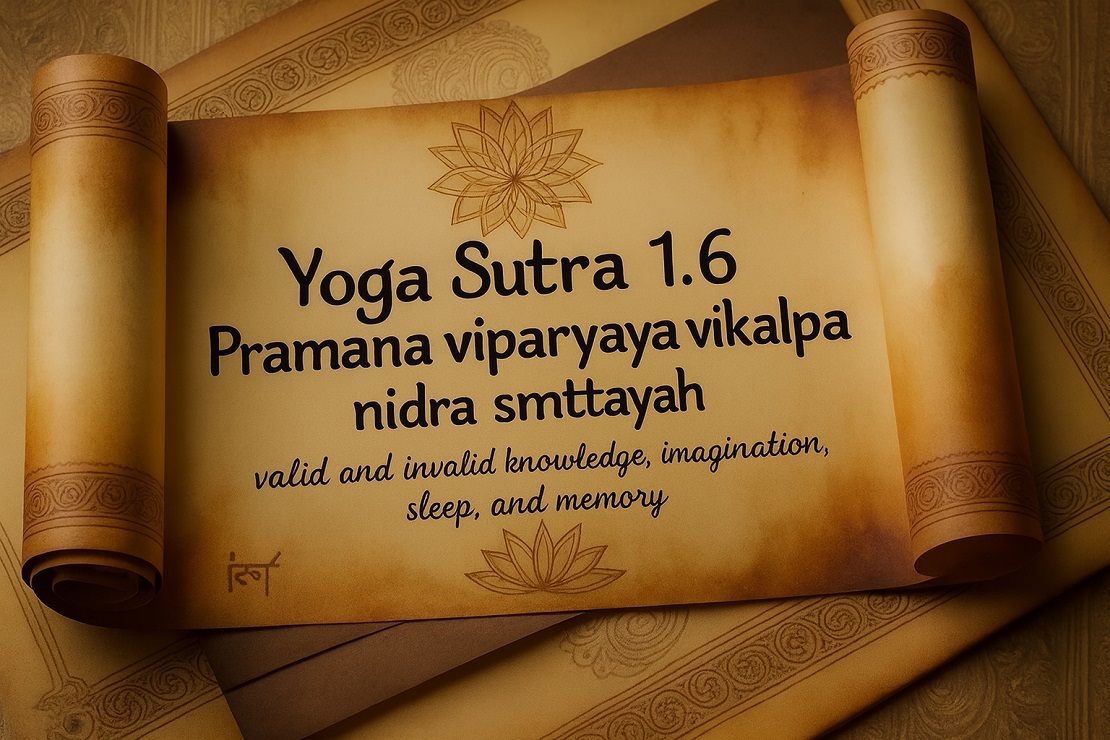
Patanjali presents a potent mental map in Yoga Sutra 1.6:
Pramana viparyaya vikalpa nidra smrtayah—refers to five different kinds of vrttis, or mental adjustments.
These vrttis influence our worldview, life experiences, and reactions to circumstances. Whether we are meditating, working, or involved in everyday routines, these brain patterns are always active. By learning to see and understand them, we begin the fundamental journey of yoga—the trip inward.
Sutra 1.6: A Framework for Inner Awareness
The five types of mental modifications are –
right knowledge,
misperception,
imagination,
sleep,
and memory,
This is how the Sanskrit verse is translated. These five vṛttis define the landscape of the mind. Thoughts ripple across awareness in the same way as waves sweep across the ocean’s surface. Yoga does not ask us to eradicate these waves, but to comprehend them so we are not swept away.
Let’s explore each vṛtti:
1. Pramana: Appropriate Knowledge
Pramana refers to valid knowledge or accurate perception. It arises from:
- Firsthand knowledge
- The application of logic
- Reliable testimony
This form of vṛtti encourages clarity and sensible decision-making. When you clearly view reality as it is, your behaviours become aligned, grounded, and stable.
2. Viparyaya — Wrong Knowledge
Viparyaya is a misperception or a misunderstanding of what is true.
A famous example is mistaking a rope for a snake in weak light.
The item exists, but the perception is twisted. Viparyaya brings on confusion, anxiety, and emotional disorders. Much of our sorrow originates not from events themselves but from misinterpreting them.
3. Vikalpa — Imagination
Vikalpa refers to thoughts that are based on words or concepts, without a physical object behind them. One should know that imagination can be creative and beneficial, but when uncontrolled, it mostly leads to stress, fantasy, or superfluous mental noise. These are thoughts that feel genuine but have no solid basis.
4. Nidra: Sleep
Patanjali’s Yoga Sutras, particularly this 1.6 sutra, allude particularly to dreamless sleep, which is a state where the mind is blank, but not idle. Even in the absence of conscious awareness, mental impressions persist. This vrtti serves as a gentle reminder that the mind continues to work even when we think it has stopped.
5. Smrti: Memory
Memory is the remembering of past experiences. It can inspire, guide, or teach lessons, but it can also bind us via emotional attachment or tragedy. Smrti shapes perception, altering how we respond to the present moment in light of the past.
Why Sutra 1.6 Matters in Modern Life
Yogic self-awareness is based on an understanding of these five vrttis. They provide us with the words to recognise our inner states and create space between the observer and the concept. When you identify things or situations like:
“This is viparyaya (misperception)”
“This is vikalpa (imagination)”
“This is smrti (memory resurfacing)”
When you do so, you start responding with insight instead of mere impulsive behaviour. The core purpose of yoga is to hunt down this awareness, which illuminates the mind rather than just bending the body.
How to Observe the Vrttis
- Pause and Notice – Take a time during meditation or a daily activity to notice your thoughts without judgment.
- Label Gently – Determine the sort of vrtti that you are undergoing: whether it is knowledge, imagination, drowsiness, memory, or misperception that you are experiencing. All you must remember is that perfection is not the aim, but awareness surely is.
- Redirect Your Focus – Return to your body, breath, mantra, or the present moment after noticing the vrtti. This one action breaks the loop of emotional reaction. Over time, these modest moments of clarity create inner tranquillity and mental steadiness.
Common Misunderstandings of Sutra 1.6
- Yoga requires stopping all thoughts Not true at all! Patanjali’s Yoga Sutras never state that your thoughts are harmful. Some vṛttis, notably pramana (correct knowledge), are important for a person’s state.
- During meditation, the mind must be empty The mind’s inherent state and nature is movement. Always remember, awareness, not repression, is the aim of this 1.6 Yoga Sutra.
- Every vrtti is distinct Vrttis often overlap. A recollection may spark imagination or misunderstanding. These categories assist us in identifying patterns, not cage the mind in rigid confines.
- Controlling vṛttis is instant It is a progressive refining via constant practice and non-attachment; described later in Sutras 1.12–1.16.
How Alakhyog Helps You Explore the Depths of Yoga
At Alakhyog, comprehending the mind is the first step towards practising genuine yoga. Alakhyog, situated in the tranquil embrace of Rishikesh, India’s Yoga Capital, provides a life-changing setting where traditional yogic knowledge and contemporary education collide.
Our Yoga Teacher Training Programs, right from 100-hour to 200-hour certifications, are designed to:
- Expand your knowledge about yogic philosophy.
- Strengthen your asana, pranayama, and meditation practice.
- Give you the tools you need to watch and improve the völttis
- Cultivate mental stillness and emotional resilience.
- Give you access to a helpful international yoga community.
With Yoga Alliance accreditation, competent teachers, and a holistic curriculum, Alakhyog pushes students beyond physical postures into the heart of yoga which binds you with awareness, transformation, and inner mastery.
The yogic sessions at Alakhyog enable you to experience yoga as a path of self-discovery, where the mind becomes clear, the heart opens, and the spirit grows steadfast, regardless of your level of experience.
Yoga Sutra 1.6 as a Route to Inner Freedom in Conclusion
By learning to see and understand these thought waves, we develop the power to transition from unconscious reaction to conscious awareness. Yoga Sutra 1.6 challenges us to examine ourselves, identify our mental tendencies, and enter a life of the present and clarity.
The real yogic journey starts here!
And at Alakhyog, this journey becomes a lived experience, enhanced, guided, and supported by timeless lessons and caring teachers.
FAQs
Q1: What are the five mental patterns (vrittis) that characterise the mind according to Yoga Sutra 1.6?
Right Knowledge (Pramana), Misperception (Viparyaya), Imagination (Vikalpa), Sleep (Nidra), and Memory (Smrti) are the five vrittis.
Q2: What is the major purpose of recognising these vrttis in yoga philosophy?
The goal is mental clarity and non-reaction, accomplished by differentiating the observer from the thought pattern itself.
Q3: How can detecting Viparyaya(Misperception) relieve emotional distress in daily life?<
By realising that misery typically originates from misinterpreting reality (e.g., mistaking a rope for a snake) rather than the event itself.
Q4: Which of the five vrttis stands for ideas that are entirely composed of words or concepts without any tangible objects?
Vikalpa (Imagination), which causes mental cacophony, worry, or imagination without a solid factual basis.
Q5: Does the practice of yoga aim to erase the five vrttis from the mind permanently?
No, the purpose is awareness and regulation, not repression, as Pramana (Right Knowledge) is important for clear decision-making.