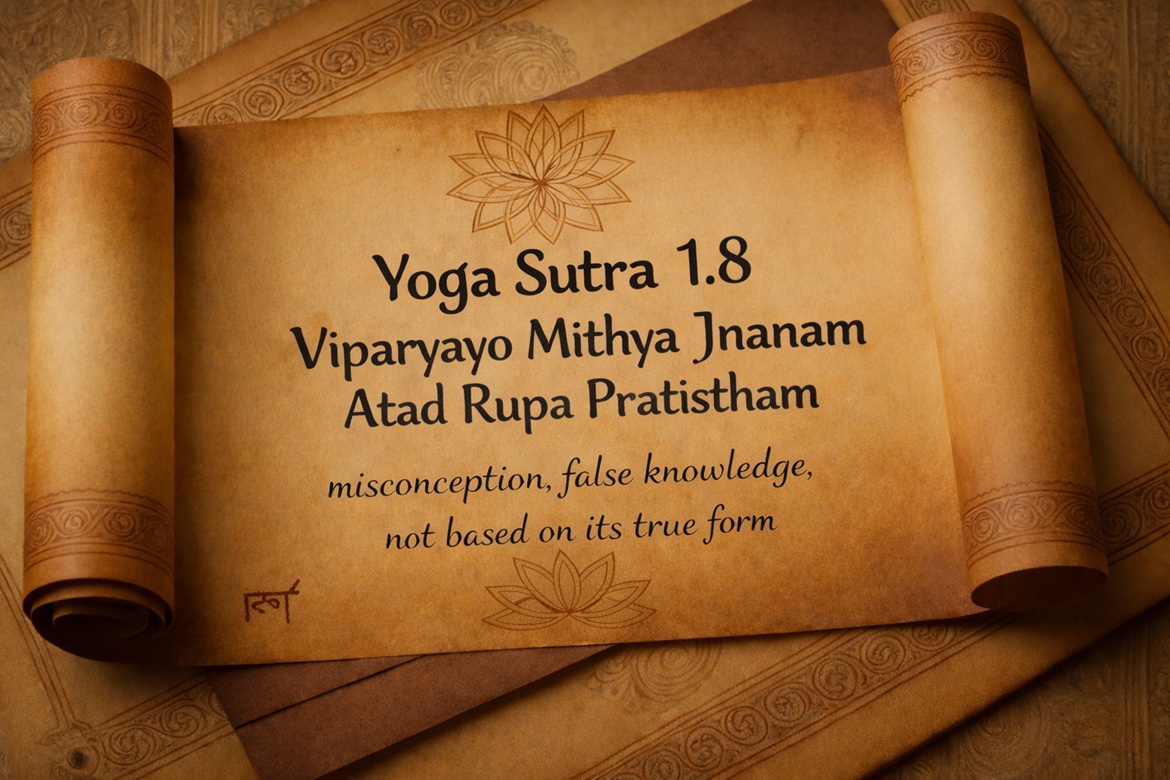
Yoga, as outlined by Sage Patanjali in the Yoga Sutras, provides profound insight into the nature of the mind, perception, and reality. Among the 196 sutras, Yoga Sutra 1.8: Viparyayo Mithya Jnanam Atad Rupa Pratistham stands out for its clarity on the difference between true knowledge (prama) and false knowledge (viparyayo).
This sutra translates to:
“Perception that is contrary to reality is false knowledge, based on the wrong concept of form.”
It emphasizes that our misperceptions often arise from distorted understanding, assumptions, or attachment to appearances.
Understanding the Sanskrit Terms
Breaking down the sutra helps clarify its meaning:
- Viparyayo – Misperception or misconception
- Mithya Jnanam – False knowledge or ignorance
- Atad Rupa Pratistham – Based on something unreal or misleading in form
Together, this sutra teaches that false knowledge arises when the mind interprets reality incorrectly.
What Yoga Teaches Us About Viparyaya
Patañjali doesn’t tell us to “stop thinking”—he teaches us to see clearly. The aim isn’t to suppress thoughts but to observe and investigate them.
Through practices like:
- Mindfulness
- Meditation
- Svadhyaya (self-study)
- Vairāgya (dispassion)
We can gradually peel away the layers of viparyaya, uncover false perceptions, and reconnect with what is real and true.
How Viparyaya Manifests in Daily Life
Viparyaya, or false knowledge, isn’t just a philosophical idea—it appears in everyday life:
- Judging by Appearances – Misunderstanding people based on superficial traits.
- Assumptions and Biases – Preconceived notions cloud objective perception.
- Attachment to Material Forms – Believing wealth, beauty, or status guarantees happiness.
- Misinterpretation of Experiences – Emotions like fear or desire distort perception of events.
Viparyaya vs. True Knowledge
Patanjali highlights the contrast between:
- True Knowledge (Prama): Arises from correct perception, reasoning, and direct experience.
- False Knowledge (Viparyaya): Results from misinterpretation, illusion, or ignorance.
Yoga emphasizes cultivating clarity of mind so that we can distinguish real from unreal. Believing material success guarantees happiness or judging others hastily are classic examples of viparyaya.
The Mind as the Source of Viparyaya
The mind is central to both knowledge and misconception. According to Patanjali, viparyaya arises when the mind interprets reality incorrectly:
- Root Cause: Identification of the self with the body, mind, or ego.
- Effect: Confusion, suffering, and spiritual stagnation.
Yoga practices such as meditation (dhyana), mindfulness, and self-inquiry (viveka) help purify the mind, enabling recognition of true knowledge.
Practical Applications of Yoga Sutra 1.8
This sutra is highly practical and can be applied in modern life:
- Mindfulness in Perception –Observe your thoughts and judgments without attachment. Mindfulness reduces false assumptions and promotes accurate understanding.
- Emotional Awareness-Identify emotional distortions in perception. Awareness of emotions like anger, fear, or desire prevents misjudgment of situations.
- Self-Inquiry-Question beliefs and assumptions. Ask, “Is this perception true, or is it based on personal bias?” This cultivates discernment.
- Detachment from Materialism-Recognize the impermanence of forms and reduce attachment to external objects for mental clarity.
Viparyaya and Spiritual Growth

In the spiritual context, viparyaya is a barrier to liberation (moksha). False identification with body and mind creates suffering. By understanding this sutra, spiritual aspirants learn to:
- Distinguish the real from the unreal
- Reduce mental suffering caused by attachment and misperception
- Pursue wisdom (jnana) alongside physical yoga practices
Without this understanding, physical practices (asana) and breathwork (pranayama) remain limited in their transformative potential. Yoga Sutra 1.8 emphasizes the need for mental clarity and self-awareness.
Applying Sutra 1.8 in Modern Life
Even today, this sutra is highly relevant:
- Workplace: Avoid assumptions; verify facts before reacting.
- Relationships: Open communication prevents misperceptions.
- Mental Health: Recognize cognitive distortions to reduce anxiety and stress.
- Personal Growth: Question limiting beliefs; cultivate self-awareness.
By integrating these teachings, one aligns with the essence of yoga: liberation from mental bondage and union with the true Self.
Viparyaya in the Age of Social Media and AI
Viparyaya, or false knowledge, arises when we misperceive reality. Today, social media and AI amplify it through curated content, fake news, deepfakes, and algorithmic biases. Filtered posts, sensational headlines, and AI-generated media create distorted perceptions, leading to envy, fear, or confusion.
Yoga philosophy offers solutions: mindful awareness, self-reflection, digital detox, and discernment (viveka). By questioning what we see online and observing our reactions, we can reduce false perceptions, cultivate clarity, and align with reality—just as Patanjali taught.
Conclusion
Yoga Sutra 1.8: Viparyayo Mithya Jnanam Atad Rupa Pratistham teaches that much of our suffering arises from false knowledge. Misperceptions, attachments, and assumptions distort reality, leading to emotional and spiritual challenges.
Through mindfulness, meditation, and self-inquiry, we can recognize viparyaya, cultivate true knowledge, and experience life with clarity, wisdom, and inner peace.
This sutra remains a timeless guide for yoga practitioners in Rishikesh, Goa, or anywhere in the world, emphasizing the importance of discernment on the path to self-realization.
FAQs
What does Yoga Sutra 1.8 mean
Yoga Sutra 1.8, “Viparyayo Mithya Jnanam Atad Rupa Pratistham,” translates to “Misconception is false knowledge not based on the true form of an object.” It explains that wrong understanding arises when perception does not correspond to reality.
What is Viparyaya in yoga philosophy
Viparyaya means misconception or delusion. It refers to the mental error where one perceives or interprets something incorrectly—mistaking the unreal for the real.
How is Viparyaya different from Pratyaksha (direct perception)
Pratyaksha represents accurate, direct perception based on reality, while Viparyaya is incorrect perception or misunderstanding caused by ignorance, assumptions, or illusion.
Can Viparyaya be corrected
Yes. Viparyaya can be corrected through self-awareness, meditation, and proper discernment (viveka). Patanjali’s Yoga Sutras guide practitioners to develop clarity and correct perception through mindfulness and practice.
How does Yoga Sutra 1.8 relate to daily life
This sutra reminds us to question our beliefs and perceptions. Many conflicts and sufferings arise from misunderstanding reality. Practicing awareness helps in seeing things as they truly are, leading to mental peace and wisdom.